
Dissemination of WP1
Dissemination of WP1 was performed primarily in international scientific conferences focused on environmental science, environmental technologies, circular economy and sustainability. Specifically, Dr. Pavlopoulos Charalampos presented orally (Figure 1) the work titled “Biogas upgrade with green hydrogen in a semi-pilot trickle bed reactor” at 19th International Conference on Environmental Science and Technology, Kos, Greece. Additionally, Dr. Konstantina Papadopoulou presented orally (Figure 2) the work titled “CO2 capture and biological conversion to CH4 using hydrogenotrophic methanogens in a trickle bed reactor” at 2nd International Conference: Circular Economy – The pathway towards a Sustainable Development, Chania, Greece.

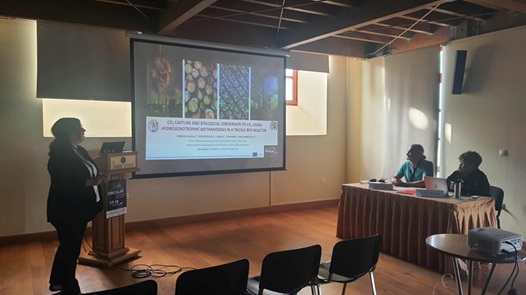
Below are listed the conference participations and their respective abstracts:
- Papadopoulou, K., Pavlopoulos, C., Riglis, C., Tsilifonis, E., Markopoulou, A., Fotopoulos, D., Papathanasiou, A., & Lyberatos, G. (2025, September 3-6). Biogas upgrade with green hydrogen in a semi-pilot trickle bed reactor. https://doi.org/10.30955/gnc2025.00436
Abstract: The current study investigated the performance of biological methanation of CO2 using green H2 in a mesophilic (37) trickle bed reactor (TBR) (0.051m3) at ambient pressure. For both phase A and phase B a synthetic gas feed (60/40 CH4/CO2) was used to simulate biogas. Nitrogen was used in phase A for better monitoring of the system. For phase A the average productivity of methane was 3.2 at methane content of 71.3% with 10.3% N2 . For phase B no Nitrogen was used, and the average productivity of methane was 1.3 at methane content of 97.9% with less than 0.1% residual H2.
- Papadopoulou, K., Pavlopoulos, C., Riglis, C., Tsilifonis, E., & Lyberatos, G. (2025, September 17-19). CO2 capture and biological conversion to CH4 using hydrogenotrophic methanogens in a trickle bed reactor. HSCE2025 oral presentation, 2nd International Conference: Circular Economy – The pathway towards a Sustainable Development, Chania, Greece.
Abstract: Carbon neutrality, also known as “net zero carbon,” refers to the balance achieved when the amount of carbon dioxide released into the atmosphere is equal to the amount removed. Achieving carbon neutrality is essential in addressing climate change. The buildup of greenhouse gases—especially carbon dioxide—in the atmosphere is the main cause of global warming. By reaching carbon neutrality, we can help stabilize and ultimately decrease these gas concentrations, reducing the harmful impacts of climate change and convert it to energy (Biomethanation). Europe, as a pioneer in environmental protection, has made significant progress in the Waste-to-Energy sector, resulting in biofuels—and especially biogas—becoming the main source of renewable energy on the continent.
This research work examines the production of biomethane using H2 and CO2 in an anaerobic semi-pilot Trickle Bed Reactor (TBR) with a total volume of 70.5 L. The method applied is based on the ability of hydrogenotrophic microorganisms to carry out the methanogenesis reaction.
The reactor was designed and constructed with design parameters, modifications, and equipment selection constitute a core part of the study.
The reactor’s operation was divided into four phases, during which different conditions were applied, and in-between phases the TBR was modified accordingly to improve its performance. Initially, anaerobically digested sludge was used as the inoculum, but in subsequent inoculations, activated sludge from the Municipal Wastewater Treatment Plant was preferred.
During the Phase I of operation, the reactor became non-functional due to excessive acetic acid production and microbial degradation.
In the Phase II, low gas loadings and high conversion rates caused a significant pressure drop in the reactor, leading to the connection of a nitrogen (N2) cylinder—an inert gas—which was supplied at high flow rates to act as a carrier gas.
The system stabilized during the Phase III of operation, where H2 consumption reached 99 ± 1.8% and the maximum CH4+N2 content was 98.3% with the TBR's productivity reaching 1.57 m3 /m3 TRICKLE_BED /d.
In the Phase IV, where gas loadings were increased, the biomethane productivity ultimately reached 1.74 ± 0.33 L/L TRICKLE_BED /day, with an average composition of 95.4 ± 1.79% CH4+N2, 4.0 ± 2.13% CO2, and 0.5 ± 1.7% H2.
A common factor across all four phases was the maintenance of high N-NH3 concentrations (>1500 mg/L) in order to regulate the production of volatile fatty acids (VFAs).
These oral presentations attracted attention of scientific community and received invitations for publications in
1: Special Issue of ENERGY NEXUS Journal (Elsevier, I.F. 9.5, Citation Score 16.1) on the VSI “Energy Innovations for Sustainable Future” and
2: Special issue in the journal ‘Circular Economy and Sustainability’, respectively. These publications are under preparation for submission within the 1st semester of 2026.
In parallel with conference dissemination activities, the scientific outcomes of WP1 have been consolidated into a full-length research article entitled “Anaerobic treatment of potato processing wastewater in an Upflow Anaerobic Sludge Blanket (UASB) reactor and ex situ biomethanation in a trickle bed reactor (TBR)”, which has been submitted to the international peer-reviewed journal Journal of Environmental Chemical Engineering (Elsevier). The manuscript was submitted under the reference number JECE-D-25-21734. The manuscript primarily focuses on anaerobic treatment of real potato processing wastewater in a UASB reactor, combined with an in-depth performance assessment and ADM1-based process modelling, constituting a core scientific contribution of WP1. The ex situ biomethanation experiments in a semi-pilot trickle bed reactor are included as a complementary component, demonstrating the potential for downstream biogas upgrading with green hydrogen and linking WP1 outcomes with the project’s broader objectives on renewable gas production.
Abstract: Rising energy demand and declining fossil resources have increased interest in renewable solutions. Biogas from anaerobic digestion provides both energy recovery and waste and wastewater treatment, yet its fuel use is limited by CO2 and H2S impurities that lower calorific value and damage equipment. Upgrading is therefore essential, with biological routes such as hydrogen-assisted CO2 biomethanation offering a sustainable alternative. In this study, potato processing wastewater was treated in a 12 L Upflow Anaerobic Sludge Blanket (UASB) reactor for biogas production, followed by ex situ upgrading in a Trickle Bed Reactor (TBR) supplied with green hydrogen. The performance of the UASB reactor was systematically evaluated with the aim of achieving stable operation and enhanced methane yield.
Over 170 days of operation, the UASB reactor was tested under different hydraulic retention times (HRT) and organic loading rates (OLR), reaching a maximum biogas production of 14.5 ± 3.2 L/d with 74.5 ± 2.1% CH4 at an OLR of 3.5 g COD/L·day and an HRT of 1.2 days. Subsequent upgrading the biogas in the TBR for 35 days yielded a maximum biomethane purity of 98.1%. Key operational parameters were further simulated using the ADM1 framework through dedicated modeling software, allowing for a mechanistic assessment of process dynamics. These results highlight the efficiency of the UASB reactor for methane-rich biogas production from industrial effluents and demonstrate the potential of coupling with a TBR system for cost-effective, high-purity ex-situ biomethanation.