ABSTRACT-SCOPE
GREENUPGRADE
Valorization of green energy for enhancing the robustness and upgrading performance of anaerobic digestion systems– is a project aimed to address critical issues that bound biogas upgrading with biological processes fromtheir successful scale-up.
The targeted breakthrough of the this work is a combination of multiple actions that will boost alternative solutions towards their practical implementation. In order to achieve this goal, during GREENUPGRADE, different biological systems are constructed, operated and compared in terms of biogas upgrading and wastewater treatment. During GREENUPGRADE a trickle bed reactor (TBR) reactor is combined with an up-flow anaerobic sludge blanket (UASB) reactor and operate as an ex-situ biogas upgrading unit. The biogas is produced from the UASB reactor. Additionally, in-situ biogas upgrading is explored using an UASB reactor with hydrogen injection using microbubbles. Only recently scientists found that the integrated MEC-AD technology (electrofermentation) is a promising solution for simultaneous wastewater treatment and biogas upgrading.
This project explores the synergistic effect of hydrogen injection and applied potential in an MEC- AD reactor, on biogas production rate and quality. Additionally, a prototype MEC-AD bioreactor with multiple cathode electrodes is constructed and operates for higher exploitation of the AD bulk. All systems are assessed in terms of biogas production rate and quality and wastewater treatment under various operational parameters (gas feeding rate, gas diffusion system, different operation modes, gas flow rate,different types of real wastewaters, applied voltage, number of cathode electrodes for the MEC-AD units etc.)
Acknowledgements
GREENUPGRADE
The research project “GREENUPGRADE: Valorization of green energy for enhancing the robustness and upgrading the performance of anaerobic digestion systems” is implemented in the framework of H.F.R.Icall “Basic research Financing (Horizontal support of all Sciences)” under the National Recovery and ResiliencePlan “Greece 2.0” funded by the European Union – NextGenerationEU (H.F.R.I. Project Number: 15522).
CET 2025, 19th International Conference on Environmental Science and Technology, Kos, Greece
Fragkos, G. Kanellos, E. Kotsikas, E. Pournara, A. Tremouli, G. Lyberatos, A. Vlysidis. Α Microbial Electrolysis Cell-assisted Anaerobic Digestion process for enhanced treatment of industrial potato processing wastewater. CEST 2025, 19th International Conference on Environmental Science and Technology, Kos, Greece, 3-6 September 2025. [Accepted].
G. Kanellos, O. Fragkos, D. Flari, A. Tremouli, G.Lyberatos. The synergistic effect of H2 injections and applied potential on biogas production during the treatment of industrial potato processing wastewater in a Microbial Electrolysis Cell-assisted Anaerobic Digestion system. CEST 2025, 19th International Conference on Environmental Science and Technology, Kos, Greece, 3-6 September 2025. [Accepted].
Communication and dissemination activities
Work Packages
The work plan of GREENUPGRADE has been structured in 4 Work-Packages (WPs)
that cover a 24 (2 years) time period.
Particularly, during WP1 a UASB reactor and a TBR for ex situ biogas upgrading will beconstructed and operated under various conditions. The main aim of WP1 is to evaluate the TBR system as a biogas upgrading technology for the biogas produced from a UASB reactor by using hydrogen source from a hydrogen generator (electrolyzer). In parallel, during WP2, the enhancement of biogas production is tested by injecting hydrogen in a UASB bioreactor.
Furthermore, the main aim ofWP3 is the construction and operation of two novel MEC-AD bioreactors for biogas upgrading. WP4 focus on the dissemination and exploitation of all the valuable data produced from the project. The project’s final target is to propose the most promising biological methods (via hydrogenotrophicmethanogenesis or electrofermentation) for biogas upgrading, at the end of the project life
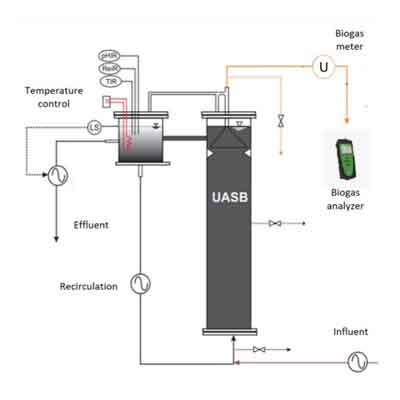

A) UASB reactor, B) gas-liquid separator, C) water bath for temperature control and D) recilculation line with pH and ORP electrodes
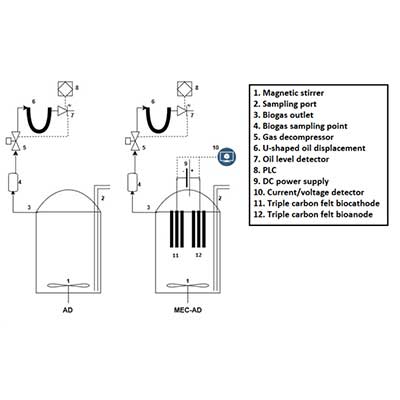
The AD reactor (on the left) and MEC-AD reactor (on the right)
Dissemination of Greenupgrade innovation
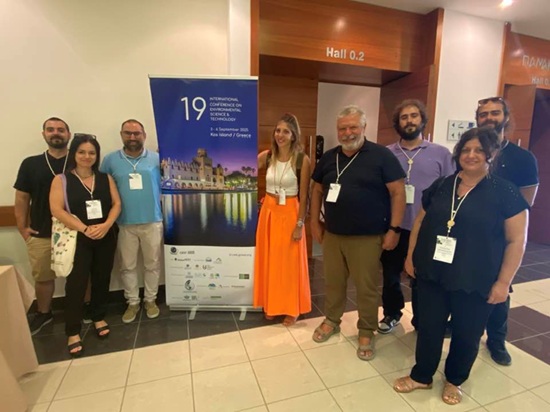
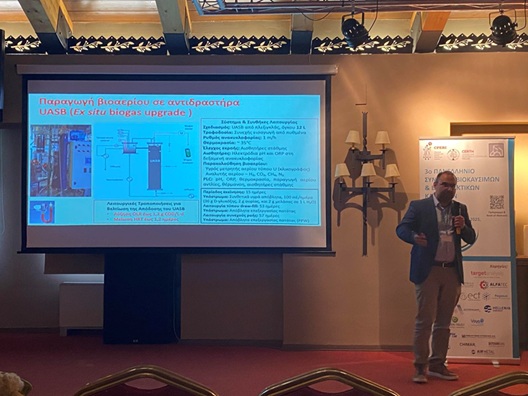
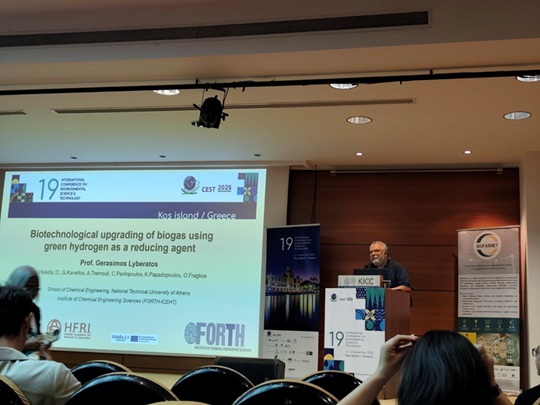
The innovation and significance of the GREENUPGRADE project were highlighted through the experience and expertise of Professors Gerasimos Lyberatos and Anestis Vlysides, who presented and promoted the project’s objectives and outcomes at both international and national conferences. Specifically, professor Anestis Vlysides presented orally (Figure 3) the work titled “Development of alternative ways to utilize green hydrogen for upgrading biogas produced during anaerobic digestion of waste and biomass” at 3rd Panhellenic Conference on Biofuels and Alternative Fuels, May 15-16, 2025, Lake Plastira. Furthermore, professor Gerasimos Lyberatos performed a plenary speech (Figure 4) titled “Biotechnological upgrading of biogas using green hydrogen as a reducing agent” at International Conference on Environmental Science and Technology (CEST2025), Kos island, Greece 3 / 6 September 2025.
Below are listed the conference participations and their respective abstracts:
- Anestis Vlysidis, D. Theodosi, G. Kanellos, A. Tremouli, Ch. Pavlopoulos, K. Papadopoulou, O. Fragkos, G. Lyberatos. Development of alternative ways to utilize green hydrogen for upgrading biogas produced during anaerobic digestion of waste and biomass, 3rd Panhellenic Conference on Biofuels and Alternative Fuels, May 15-16, 2025, Lake Plastira.
Abstract: Anaerobic digestion is one of the most important processes for the valorization of biomass and wastes for the production of biogas, which mainly consists of methane and carbon dioxide. In order to improve process efficiency, hydrogen produced via water electrolysis using surplus electrical energy generated by photovoltaic systems and/or wind turbines can be exploited. In this way, this surplus energy is stored in the form of chemical bonds, since hydrogen reduces carbon dioxide to methane. Within the framework of the GREENUPGRADE research project, different approaches for upgrading biogas to methane are being investigated. Specifically, the process of hydrogenotrophic methanogenesis is studied, as well as the effect of applying an electrical potential to anaerobic digestion (electrofermentation), both on waste treatment and on the quantitative and qualitative upgrading of biogas. Within GREENUPGRADE, a trickle-bed reactor (TBR) has been constructed and is being optimized, into which hydrogen and biogas are supplied. The TBR upgrades biogas and treats the effluent of an up-flow anaerobic sludge blanket (UASB) reactor, thus achieving ex situ biogas upgrading. In parallel, a second UASB reactor has been constructed and is being optimized, into which hydrogen is injected in the form of microbubbles in order to achieve effective mass transfer of hydrogen from the gas to the liquid phase, leading to in situ upgrading of the produced biogas. Finally, within the framework of the project, the emerging and highly promising technology of electrofermentation is also being investigated. All systems are evaluated in terms of biogas production rate and biogas quality, as well as the treatment performance of the processed wastes.
- Lyberatos A. Vlysidis, D., G. Kanellos, A. Tremouli, C. Pavlopoulos, K. Papadopoulou, O. Fragkos Biotechnological upgrading of biogas using green hydrogen as a reducing agent, Plenary speech at International Conference on Environmental Science and Technology (CEST2025), Kos island / Greece 3 / 6 September 2025.
Abstract: The replacement of fossil fuels by renewable energy sources is one of the most important steps for the reversal of climate crisis through circular economy. The contribution of solar and wind energy has been continually increasing in the recent years to this end. To fully exploit their potential, their storage as chemical energy in the form of green hydrogen or methane is of paramount importance. Green hydrogen generated via electrolysis of water using the surplus electricity generated by photovoltaic cells is employed in this work for the reduction of the carbon dioxide contained in biogas to methane. This leads to almost complete upgrading of the biogas generated via anaerobic digestion of the wastewater generated by a potato processing industry. The upgraded biogas may then be injected into the natural gas network, used in a combined heat and power (CHP) process or used as transportation fuel in the form of bioCNG. Two alternative approaches are examined. The first is an ex situ process: biogas is generated in a UASB reactor and co-fed with green hydrogen to a mesophilic trickling bed reactor (TBR) in order to be upgraded to biomethane via hydrogenotrophic methanogenesis. In the second alternative, green hydrogen is fed as microbubbles to a wastewater processing UASB reactor for an in-situ enrichment of biogas to biomethane. A third alternative also examined is the direct use of the generated electricity with or without hydrogen addition in a microbial electrolysis cell anaerobic digestion (MEC-AD) system.
These presentations served as a catalyst for interaction and networking with experts from related scientific and technological fields, enabling the exchange of views, the identification of common research interests and the exploration of potential future collaborations.
Conclusions