
Dissemination of WP2
Dissemination of WP2 was performed primarily in an international scientific conference focused on environmental science, environmental technologies, circular economy and sustainability. Specifically, Dr. Dimitra Theodosi Palimeri presented orally (Figure 3) the work titled “Optimization of Biogas Production and In-Situ Upgrading via Hydrogenotrophic Methanogenesis in a Lab-Scale UASB Reactor” in the topic “Energy Technologies” at the 19th International Conference on Environmental Science and Technology (CEST2025), 3–6 September 2025, Kos Island, Greece.
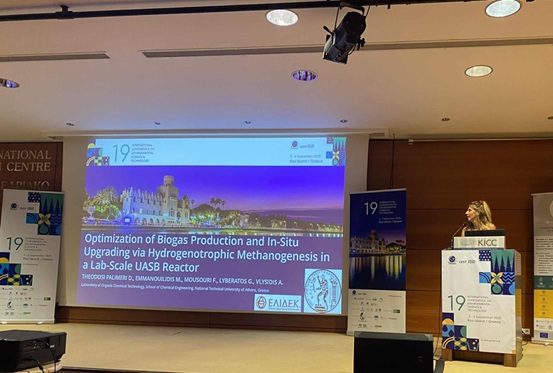
Details of the conference presentation and the corresponding abstract are provided below:
Theodosi Palimeri, D., Emmanouilidis, M., Moussouri, F., Fotopoulos, D., Papathanasiou, A., Lyberatos, G., & Vlysidis, A. (2025, September 3–6). Optimization of Biogas Production and In-Situ Upgrading via Hydrogenotrophic Methanogenesis in a Lab-Scale UASB Reactor. 19th International Conference on Environmental Science and Technology (CEST2025), Kos Island, Greece.
https://doi.org/10.30955/gnc2025.00175
Published in the proceedings of the Global NEST International Conference on Environmental Science & Technology, ISSN: 2944-9820.
Abstract: The increasing demand for sustainable bioenergy has strengthened interest in biogas upgrading technologies that aim to produce pure CH4 by separating CO2 and other impurities. This study investigates the in situ biomethanation of CO2 through hydrogen feeding in a 7 L UASB reactor treating synthetic and potato-processing wastewater.
After stabilization under varying HRT and OLR conditions, hydrogen was introduced either into the feed line or the recirculation line using a microbubble generation system. Hydrogen injection into the feed line increased biogas production by 18% and methane concentration to 70.9%, while reducing CO2 to 5.2%. Injection into the recirculation line further improved methane purity (78.8%) and TOC removal (74.3%).
Doubling the hydrogen flow resulted in the highest biogas production (4.6 ± 0.7 L/day) and TOC removal (83.97%), despite a slight reduction in methane content.
Across all conditions, hydrogen addition minimized VFA accumulation and enhanced process stability. Overall, in situ hydrogen injection proved effective for improving methane yield and biogas quality, demonstrating strong potential for sustainable biogas upgrading from industrial wastewaters.
In addition to conference dissemination, the outcomes of WP2 are being prepared for publication in a peer-reviewed scientific journal. Following the oral presentation at CEST2025, the work entitled: “Optimization of Biogas Production and In-Situ Upgrading via Hydrogenotrophic Methanogenesis in a Lab-Scale UASB Reactor” was selected for submission to the Special Issue of ENERGY NEXUS (Elsevier) entitled “Energy Innovations for Sustainable Future (CEST2025)”.
An extended and significantly improved journal manuscript is currently in an advanced stage of preparation, and is planned to be submitted from February 2026 onwards, within the Special Issue timeframe (final manuscript submission deadline: June 2026).
The manuscript is based on the experimental and modelling results of WP2 and focuses on hydrogen-assisted anaerobic digestion of potato processing wastewater in a UASB reactor, examining the impact of hydrogen microbubble injection strategies on methane productivity, biogas quality and process stability, supported by ADM1-based modelling.
The full abstract of the prepared journal manuscript is provided below.
Abstract: Growing interest in renewable energy recovery from wastewater has intensified efforts to improve both the productivity and composition of biomethane via anaerobic digestion. This study evaluated the in situ biological methanation in a 7 L mesophilic Upflow Anaerobic Sludge Blanket (UASB) reactor treating potato-processing wastewater, focusing on the impact of hydrogen microbubble addition on methane enrichment. The system was operated across a range of hydraulic retention times (HRTs) and organic loading rates (OLRs) up to approximately 3 g COD·L-1·d-1, maintaining stable performance. Hydrogen was supplied either through the influent feed or via the recirculation line, leading to distinct upgrading responses. Hydrogen delivery through the feed stream primarily enhanced biogas quality, increasing the CH4/CO2 ratio by 49.5% compared with the baseline scenario (i.e., no hydrogen feed), whereas hydrogen dosing through recirculation preferentially enhanced biomethanation, increasing methane production by 62.4% relative to baseline operation (291.8 ± 84.1 mL CH4·L-1·d-1) when 2 L H2·d-1 was supplied. Under intensified hydrogen supplementation (64 mL/min into the feed tank) combined with a higher OLR (2.7 gCOD·L-1·d-1), methane productivity more than doubled compared with baseline, reaching 657.4 ± 105.2 mL CH4·L-1·d-1, while methane content increased from 65-70% to consistently above 78%. Subsequently, ADM1 simulations reproduced the main process tendencies and supported strengthened hydrogenotrophic methanogenesis under hydrogen availability, with remaining deviations attributed to gas–liquid mass transfer constraints. Overall, controlled in situ hydrogen delivery proved effective for upgrading biogas quality while markedly increasing methane production, offering a practical route for biomethane generation within high-rate anaerobic treatment systems.