
Dissemination of WP3
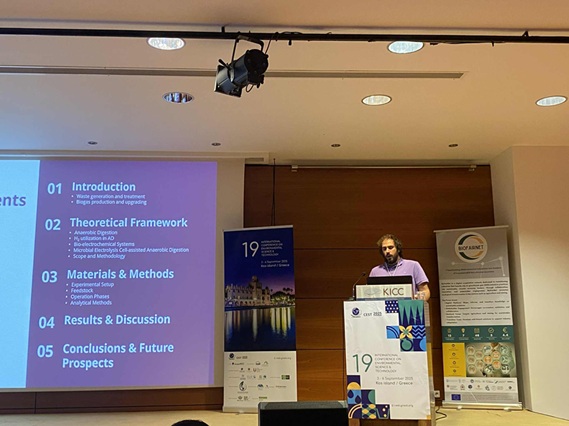
Dissemination of WP3 was performed primarily in international scientific conferences focused on environmental science, environmental technologies, circular economy and sustainability. Specifically, Dr. Gerasimos Kanellos presented orally (Figure 4) the work titled “The synergistic effect of H2 injections and applied potential on biogas production during the treatment of industrial potato processing wastewater in a Microbial Electrolysis Cell-assisted Anaerobic Digestion system” in the 19th International Conference on Environmental Science and Technology in Kos Island/Greece 3-6 September 2025.
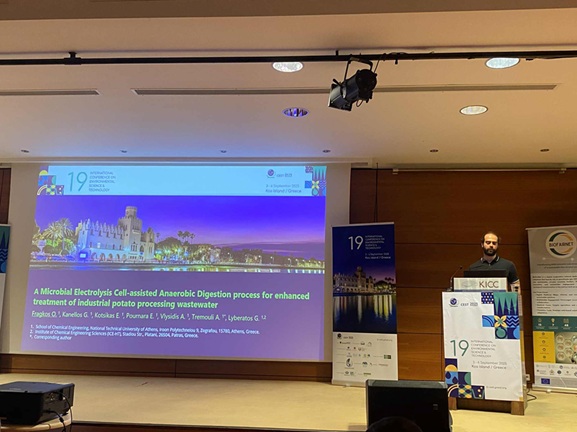
Also, PhD candidate Orfeas Fragkos presented orally (Figure 5) the work titled “Α Microbial Electrolysis Cell-assisted Anaerobic Digestion process for enhanced treatment of industrial potato processing wastewater” in the 19th International Conference on Environmental Science and Technology in Kos Island/Greece 3-6 September 2025.
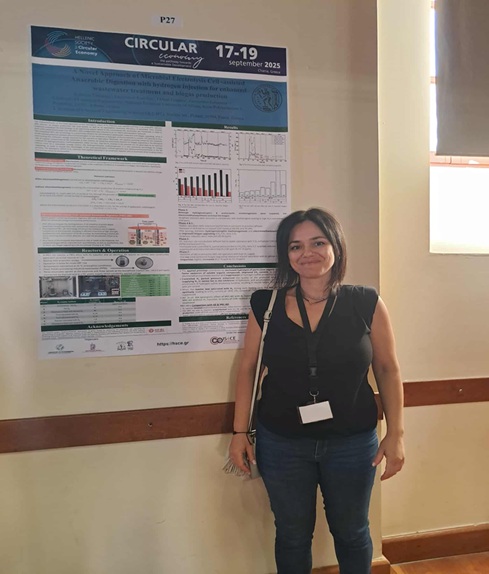
Additionally, Dr Asimina Tremouli did a poster presentation (Figure 6) in the work titled “A Novel Approach of Microbial Electrolysis Cell – assisted Anaerobic Digestion with hydrogen injection for enhanced wastewater treatment and biogas production” in the 2nd International Conference “Circular Economy: the pathway towards a Sustainable Development” of the Hellenic Society for Circular Economy, 17-19 September 2025 in Chania, Greece.
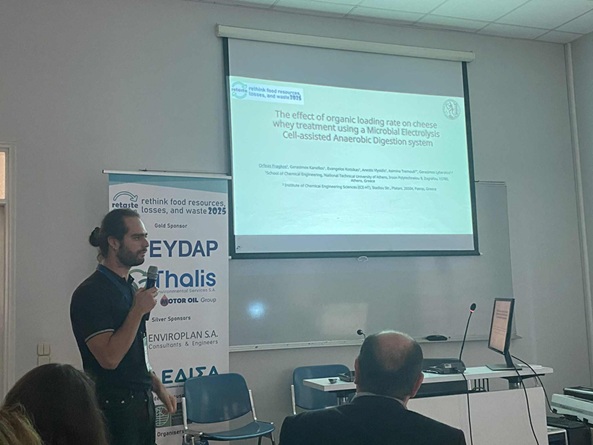
Finally, PhD candidate Orfeas Fragkos presented orally (Figure 7) the work titled “The effect of organic loading rate on cheese whey treatment using a Microbial Electrolysis Cell-assisted Anaerobic Digestion system” in Retaste 2025, Rethink food resources, losses and waste in Athens, Greece, Harokopio University, 24-27 September 2025.
Details of the conference presentation and the corresponding abstract are provided below:
CEST 2025, 19th International Conference on Environmental Science and Technology Kos Island/Greece 3-6 September 2025
The synergistic effect of H2 injections and applied potential on biogas production during the treatment of industrial potato processing wastewater in a Microbial Electrolysis Cell-assisted Anaerobic Digestion system
- Kanellos, O. Fragkos, D. Flari, A. Tremouli, G. Lyberatos
Abstract: This study presents the design and optimization of an integrated microbial electrolysis cell–assisted anaerobic digestion (MEC-AD) reactor incorporating controlled hydrogen injection to enhance biogas upgrading and process stability. The developed H₂-MEC-AD system combines electromethanogenesis, driven by an applied electrical potential, with hydrogenotrophic methanogenesis through exogenous hydrogen supply. The reactor was engineered to accommodate multiple hydrogen delivery strategies, including headspace replacement, influent saturation, and full-reactor saturation using microbubble dispersion, while maintaining geometric and electrochemical consistency with control systems.
The system was evaluated using industrial potato processing wastewater under varying organic loading rates, applied potentials, and hydrogen supply modes. Application of an external potential accelerated particulate hydrolysis and soluble organic matter oxidation, resulting in faster stabilization and enhanced sCOD removal compared to conventional anaerobic digestion. Under optimized conditions, sustained sCOD removals above 90%, low residual tCOD, and suppressed volatile fatty acid accumulation were achieved. Carefully controlled hydrogen injection further improved reactor robustness and methane upgrading performance. In contrast, excessive or poorly distributed hydrogen supply caused rapid alkalization, VFA accumulation (notably propionate), and inhibition of both methanogenic and electroactive microbial communities.
The results identify hydrogen dispersion strategy, organic loading rate, and pH control as critical parameters governing stable and efficient H₂-MEC-AD operation. Overall, the integrated approach enhances treatment efficiency, methane enrichment, and process resilience, providing a robust framework for the scale-up of hydrogen-assisted MEC-AD systems for high-strength industrial wastewater treatment.
CEST 2025, 19th International Conference on Environmental Science and Technology Kos Island/Greece 3-6 September 2025
Α Microbial Electrolysis Cell-assisted Anaerobic Digestion process for enhanced treatment of industrial potato processing wastewater
Fragkos O., Kanellos G., Kotsikas E., Pournara E., Vlysidis A., Tremouli A., Lyberatos G
Abstract: This study presents the design and long-term experimental evaluation of an integrated microbial electrolysis cell–assisted anaerobic digestion (MEC-AD) reactor for enhanced treatment of high-strength industrial wastewater and biogas upgrading. A modular cylindrical MEC-AD reactor of a total volume of 2 L and a working volume of 1.8 L) was constructed to allow progressively reduction of cathode electrode configurations while maintaining constant HRT of 15d and mesophilic conditions (35oC) under draw fill mode. Carbon felt electrodes with titanium wires were employed, and the system used a feedstock of industrial potato-processing wastewater, with an identical anaerobic digester serving as a control reactor.
The MEC-AD reactor was operated for a total of 358 days following a five phased strategy that included progressive reduction of cathode electrodes (from 3 to 1) while anode electrodes remained constant, variations in organic loading rate (0.2 to 0.5 gCOD/(L*d), and an increase in applied voltage from 1 to 2 V. The system exhibited improved operational stability compared to conventional AD, maintaining stable pH and alkalinity while suppressing volatile fatty acid accumulation. Enhanced organic matter conversion was achieved, reflected by higher COD and solids removal efficiencies and increased methane production rates. Peak methane productivity reached approximately 350 mL CH₄/(L*d), while continuous current generation confirmed sustained bioelectrochemical activity.
Overall, the results demonstrate that MEC integration strengthens anaerobic digestion performance, improves methane recovery, and allows electrode configuration optimization without compromising long-term process stability, highlighting the potential of MEC-AD systems for efficient energy recovery and biogas upgrading from high-strength industrial wastewaters.
2nd International Conference “Circular Economy: the pathway towards a Sustainable Development” of the Hellenic Society for Circular Economy, 17-19 September 2025 in Chania, Greece
A Novel Approach of Microbial Electrolysis Cell – assisted Anaerobic Digestion with hydrogen injection for enhanced wastewater treatment and biogas production
Asimina Tremouli, Gerasimos Kanellos, Orfeas Fragkos, Gerasimos Lyberatos, Anestis Vlysidis
Abstract: This study investigates the synergistic effect of hydrogen injection and applied electrical potential in an anaerobic digester using a MEC-AD configuration to enhance biogas production, quality, and wastewater treatment. The integrated MEC-AD system promotes electromethanosynthesis and accelerates organic matter oxidation (COD removal up to 95.4%), leading to improved methane yield and process stability. Hydrogenotrophic methanogenesis is exploited for in situ biogas upgrading by converting CO₂ and H₂ into CH₄ without additional energy input.
Three reactors (AD, MEC-AD, and MEC-ADH₂) were comparatively evaluated using industrial potato processing wastewater. Results showed that MEC-AD improved hydrolysis, methane content, and suppressed hydrogen sulfide formation, while MEC-ADH₂ further enhanced biogas quality (CH4:CO2 ratio 5.7 and low impurities H2S 50ppm and CO 10ppm). Excessive H₂ supply, however, caused process inhibition and reactor failure, highlighting the need for optimized operating conditions.
Retaste 2025, Rethink food resources, losses and waste. Athens, Greece, Harokopio University, 24-27 September 2025
The effect of organic loading rate on cheese whey treatment using a Microbial Electrolysis Cell-assisted Anaerobic Digestion system
Orfeas Fragkos, Gerasimos Kanellos, Evangelos Kotsikas, Anestis Vlysidis, Asimina Tremouli, Gerasimos Lyberatos
Abstract: This study evaluates a MEC-assisted anaerobic digestion (MEC-AD) system for treating cheese whey under different organic loading rates (OLRs). The reactor showed strong sensitivity to loading conditions, with high OLR (1.2 gCOD/(L*d)) causing sCOD and VFA accumulation, while low OLR (0.4 gCOD/(L*d)) enabled efficient degradation and stabilization. Intermediate performance was observed at 0.9 gCOD/(L*d), where process stability and methane quality were optimized. The highest biogas production (2.5 L/d) occurred at the highest OLR, whereas methane content peaked at 76% under moderate loading. Methane yields increased from 0.45 to 0.71 LCH₄/gCODcons, indicating improved conversion efficiency. Overall, MEC-AD proved effective for cheese whey treatment, enhancing methane production through electromethanogenesis.
In addition to conference dissemination, the outcomes of WP3 are being prepared for publication in a peer-reviewed scientific journal. Following the oral presentations at CEST2025, both works were selected for submission to the Special Issue of ENERGY NEXUS (Elsevier) entitled “Energy Innovations for Sustainable Future (CEST2025)”. Both papers are currently under development, and are planned to be submitted within the Special Issue timeframe (final manuscript submission deadline: June 2026).